Showing posts with label Writing. Show all posts

Tuesday, October 26, 2021

Action Research

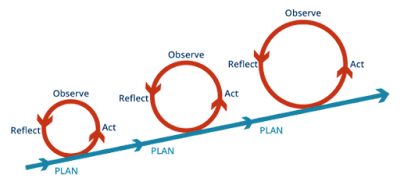
I used the action research framework as an approach for guiding my practical work. According to McNiff (2002), action research is a structured approach for improving one's practice, and it follows a cycle. The action research cycle is to plan, act, observe, and reflect. 

O'Byrne, W., (2016). Action Research Cycle.

Tuesday, September 28, 2021

M. Pujol Interview- Marketing

 I had a semi-structured interview with Michelle Pujol and got her views on my research sub-questions.

"Which marketing platforms are most appropriate for selling organic jewellery?" 

Michelle's response

She had some initial suggestions on doing mini-exhibitions she felt I needed to generate multiple collections. She also suggested I approach magazines to do small articles on my work to get my name out. Another helpful suggestion was that I should generate an explanation/story behind each piece can help it sell.

She suggested that once I have a few collections then to start thinking about setting up an online presence. She explained how there are two ways about doing this either with my own website or with an Etsy store. A useful piece of advice I received was to do the online set-up myself as paying someone to do it as it can get expensive to pay someone every time I want to add a product to the online store. 

Pujol explained the difference between a website and an Etsy store, a website can easily be set up online using Wix or WordPress but usually only access local target markets. Whereas Etsy is internationally known but is used by many crafters which means more competition.

My Response

There are not as many galleries in Durban that will rent space out to students for free so my version of mini-exhibitions to test the market would be when I display my work at the I Heart Market. The market has been closed so because I have experience with Wix I explored using it to set up my website. My focus is not on being internationally known at this point in time so I did not even look into an Etsy store.
M. Pujol Interview- Mass Production

  On Monday I had an informal interview with Michelle Pujol and got her views on my research sub-questions.

"Do you use casting or any mass production methods?"

Michelles's response

Michelle doesn't cast as she prefers making up each piece individually. She did explain that if she did have the facilities to cast she would cast elements that she could manipulate after casting to achieve her desired outcome. Therefore reducing the manufacturing time of her pieces. She feels that casting whole pieces diminish the personality of the piece.

My Response

I have the facilities to utilize lost wax casting so it is a technique I find myself using frequently. I agree with Michelle about casting elements instead of whole pieces. The difference is I manipulate the elements both while they are in wax and after they have been cast.

M. Pujol Interview- Design

 On Monday I had an informal interview with Michelle Pujol and got her views on my research sub-questions.

"How do you develop your designs?"

Michelle's respone

Michelle explained how starts with many ideas but that she sets parameters to focus her personal design briefs. She finds references which she then uses to ask herself," how can the reference be incorporated into a function or a non-functional piece."

She also gave me a few suggestions to apply to my own work. The tips included taking photos whilst manufacturing as other ideas arise. This is so the original design can be completed and the other designs can be returned to a later stage. Unfinished pieces should only be given a limited shelf life. She explained how she kept her unfinished pieces visible so that they can inspire new designs but also so that they are a reminder that they need to be completed. When manufacturing becomes overwhelming taking a step back is a good way to get a new perspective.

My Response

I struggled to find a starting point for my designs so Michelle's tips were very useful. I looked at my plant castings from last year and decided that their shelf life was up. I did not follow her suggestion about finishing the original design. Whilst I worked on my sunflower earpiece I realized I spent a lot of time working on perfecting the size of the sunflower that it was more substantial for me to produce a collection with the sunflowers I cast.

Sunday, August 1, 2021

Conclusion

All my work is aimed towards somewhat answering my research question. I will do this by looking at other jewellers to see how they influence my work. By the end of the year, I also plan on having a body of work composed of my explorations that incorporate an aspect of mass production. I hope to have all of my jewellery pieces documented using my watercolours or to at least has a collection of watercolour nature studies. I want to work towards having a completed website that I can use to sell my jewellery pieces. 

Saturday, July 31, 2021

Introduction

This progress report is to show the work I have done so far to explore my research question. I  developed sub-questions from the three main sections of my research question to guide my exploration. The three sections are design development, mass production and marketing. My explorations are separated into the three sections of my research question. Each section is comprised of the labels I generated this year. In my report, I also included influential jewellers that look at both design and marketing.

Thursday, July 22, 2021

Labels

Labels are words/tags added to the footer of each blog post as a way of grouping posts that have similar content. The labels are grouped together on the right-hand side of my blog into a label cloud, as seen in the image below. My label cloud is ordered from most frequently used, the more often a label appears the larger the word becomes. Some of my blog posts have more than one label as the posts can fit in more than one category. The cloud updates every time a new post is added to the blog; it is also a way for readers to navigate my blog.

Bowes, K., (2021). Label cloud.

Research sub-questions

 I broke up my research question into three categories then generated sub-questions to guide me in my process of exploration. They were also used as the questions in the semi-structured interview with Pujol.

Design development:

  • How do I currently develop designs, and how could I improve my design process? 

Mass Production:

  • Which mass production processes are available and which ones are most appropriate for my use?
  • How can I incorporate mass production into my manufacturing process?

Marketing:

  •  Which marketing platforms are most appropriate for selling my organic jewellery?

Wednesday, July 21, 2021

Research Question

I summarised what I want to achieve this year into one sentence, develop a design for mass production that can be tested in the market. I used my summary and Jean McNiff's Action Research (2002) approach of generating a research question to help focus my research. 

My research question: "How do I [improve the development of designs for mass production, to be tested in the market]?"

Anon. 2021. Research

Wednesday, June 2, 2021

Market vs Website

 I have been running the DUT table at the market for two years and from my experience at the market simple designs sell. Pieces that are simple sell better but it is not always about price design-wise it needs to be relatable to a large audience as there aren't the same people attending every market. The I heart market has become flooded with jewellers meaning if I want to continue with markets once I am done at DUT I have to start looking at other markets that will be available to me.

That is why I am looking at setting up a website as working with one theme, organic, means my work won't appeal to everyone. Websites can reach more people when promoted well. Also during times like this pandemic, a website won't need to close as there is no physical contact. The downside to a website is that it is taking time for me to learn how to set it up but from experience, WordPress has been easier to work in compared to Wix which I used for the Wadhwani Foundation program.

Bowes, K.,(2021). Market Table.

Tuesday, June 1, 2021

Nicole Ringgold

 Nicole Ringgold is a silversmith that is inspired by plants and objects she finds while hiking. The botanical jewellery may look cast or electroformed but it is all hand made by melting scraps of silver together. "[Ringgold's] intention is not to replicate the plants, but to recreate them with silver with as much detail as possible[; the] goal with every piece is to make the metal appear alive"(Ringgold, n.d.)

Her work interests me as she makes large sculptural pieces, I was under the impression that she made sculptures and that's how the objects stayed but looking at her website I see she uses her sculptures to make wearable pieces. I always worry about the weight of my pieces while making them I get stuck on the thought of would it sell. Ringgold's work has inspired me to take a second look at my castings from last year I didn't use them as I thought they were too large. My castings are tiny compared to Ringgold's sculptures.

Ringgold, N., (2021). Silver sunflower.

Mass Production- Jig

 Mass production is very useful when it comes to making jewellery for markets or large orders but not everything can be cast. My best selling earrings at the I Heart Market are made with thin wire that can't be cast. Inspired by the pair of pliers in the video, Rod from Phil Bear Jewellers helped me make a jig on his lathe that will work for my wire earrings. I usually make my earrings by hand but they take time to get both earrings to match which is very frustrating but with the jig, it will be easier to make many more earrings in less time.

Bowes, K.,(2021). Wire earring jig


Saturday, May 29, 2021

Jewellery Specific Entrepreneurship

 Through Instagram, I found the Halstead Jewelry Business Plan Toolkit which is a PDF document about entrepreneurship. I am currently working through the pages, they are basically a repeat of the 10week program I already did. The 10-week course was generalised but in-depth whereas the PDF is jewellery specific but doesn't go in-depth with setting up a business. 

The pages include resources for stuff like taking how to take photos of the jewellery which is going to be to be useful for setting up my website and posting on my Instagram page. Photos are the selling factor when it comes to jewellery especially when the customer can't physically hold the jewellery because it is being viewed online.


Greene, K., (2020). Halstead Jewellery Business Plan Toolkit

Thursday, May 20, 2021

Fibonacci Spiral

The Fibonacci sequence is a mathematical series of numbers that is also known as the Golden Ratio:0,1,1,2,3,5,8 (Fn = Fn-1 + Fn-2). The sequence creates a spiral(the golden angle) that occurs frequently in nature and can be seen in pineapples, waves, shells, etc. 

 Fibonacci numbers/spiral in nature
 
The Fibonacci Spiral is also found in the seeds of sunflowers as the spiral allows for the maximum amount of seeds while still having the seeds spaced evenly.

Tuesday, May 11, 2021

Entrepreneurship

I worked through a ten-week entrepreneurship, online, program run by the Wadhwani Foundation in India. The program consisted of students working in groups of threes to work on their business plan. I was grouped with two fine art students and we didn't have a business idea so we worked on a hypothetical website, on Wix that was never launched, where art and jewellery students can sell their work. The program was a lot of work but it made me realize how beneficial entrepreneurship skills are when you have practical skills that can easily be turned into a business. 

I run the jewellery departments table at the I Heart Market but due to Covid-19, the number of traders and customers at the market has decreased. After observing this I realized if I want to sell my work I need to look at other options such as selling through Instagram, Facebook or starting a website like we did for the course.

Links: summary video & Final PowerPoint

Plan

 My plan for this year is to develop a design/s that can then be mass-produced or made into spin-offs that can be tested in the market.

For me to develop a design I need to find a starting point, during my diploma the lecturers would give us a theme or a form of jewellery as our starting point. I have always struggled to find my starting point but I have settled on working towards my sunflower earring

While working on my sunflower earring I want to work on spin-offs that I can be easily mass-produced to then be sold at the market or on a website.

Bowes, K.,(2021). Workbench


Sunday, January 17, 2021

Conclusion

I was quite excited to start working with my own theme but when the pandemic hit it was difficult to stay creative without being able to make jewellery but I managed to use embroidery as my creative outlet. Once getting back to the studio I learnt new ways to do casting besides using silicone moulds to do lost wax casting. I learnt other new skills with textures that I then complemented with enamel to create some prototypes. I also realized that all of my prototypes I made refer to leaves and leaf anatomy in some way.   I want to continue using casting and enamel techniques to create finished pieces of jewellery by combining them in different ways, this will require me to do more drawings. If this pandemic is to continue I will use my time to design so that when I am in the studio I don't have to waste time, I can immediately start making jewellery pieces.

Introduction

My progress report consists of my research into organic jewellery. My research was compiled using action research methodology. This research was done using online articles and books, as well as the Virtual Gallery of Contemporary Jewellery. I used these writings to understand the functions of jewellery, organic jewellery, mixed materials, the design process and to develop my topic. My references consist of work done by professional jewellers that use different techniques and subject matter. I explain how nature influences each jeweller's work and how they relate to my prototypes. My prototypes were made using casting, enamel and texturing metal in different ways. I spent most of my time producing prototypes, with the platinum brooch being the only project that lead to a finished piece. This does not take into account the embroidery I did during the pandemic lockdown to keep busy, as that project produced masks rather than a piece of jewellery.

Explorations

After finding my references and deciding which techniques I wanted to experiment with, I started making prototypes. The techniques I wanted to work with work casting, enamelling and texture. Unfortunately, before I could really get started, the pandemic hit and we were forced to go into lockdown. This meant that I had to find new ways to work creatively at home. Therefore, I started embroidering and making face masks because they were needed at the time. 

As soon as we were allowed back into the studio, I started casting organic objects and playing with enamel stencilling. I then realized the work I had done in ceramics could be translated similarly to metal using punches and roll milling. This created textures that I enamelled over. I learnt to transfer fine details from clay into wax that could be used for casting. Textures that I also experimented with were a melted texture and using fly pressing to create intaglio and relief textures/images.

While making my prototypes, I was very inspired and the creation of one would lead straight to the making of the next. Despite this, my platinum prototypes were the only ones that I was able to turn into a finished piece. I still want to continue casting and using enamel as there are more ways to cast than just casting organic objects. I feel that if I did a bit more drawing and design work with my prototypes as a starting point, I could create finished jewellery pieces in the future that combine the techniques I learnt when making my prototypes.