Showing posts with label Research methodology. Show all posts

Thursday, December 16, 2021

Donald Schön

 Donald Schön wrote a book called The Reflective Practitioner (1983) in which he explains that creatives, " know more than they can say," and often only reveal their vast knowledge whilst actively producing work.  

"There are actions, recognitions, and judgements which we know how to carry out spontaneously; we do not have to think about them prior to or during their performance." These spontaneous actions are depicted through the decisions made whilst I design, prototype and produce my body of work. From what I understand from Schön's book "reflection in action" is done by recognizing the spontaneous decisions and recording them.

Unfortunately, I was unable to find Schön's, 1987, writing about reflection on action but I found a research paper that refers to his writing (Hugh, 1989). The paper explains how reflection on action is about learning from the experience which is usually overlooked. From this I understand that reflection on action happens after each piece has been produced.

Due to reflection in action taking place simultaneously to producing work this writing tends to be informal. Whereas reflection on action happens after the piece is completed therefore this writing is more formal.

A. Schön, D., 1983.  Sopper.dk. Available at: https://www.sopper.dk/speciale/arkiv/book49.pdf [Accessed 16 December 2021].

Hugh, M., 1989. Files.eric.ed.gov. Available at: https://files.eric.ed.gov/fulltext/ED309163.pdf [Accessed 16 December 2021].


Wednesday, November 24, 2021

Design Process

 The Universal Traveller (Koberg and Bagnall, 1981:17) has a design process that similarly follows a cycle and mirrors the action research process. The design process is acceptance, analysis, define, ideate, select, implement and, evaluate.

Koberg, D. and Bagnall, J., (1981). Design process feedback.

Even though it seems as though action research and the design process are clear cycles, I have found them to be composed of many mini-cycles, intersecting cycles and overlaps between the two. 

Wednesday, October 27, 2021

Implementation of methodology

 My online journal (blog) is the resource I use the most to document my work and can be used to show how I follow the Action Research cycle, as proposed by McNiff (2002). I also use routine discussions with a critical friend for guidance and self-correcting. According to McNiff," critique is essential for helping us to evaluate the quality of the research." Although the discussions are not formally documented, some of the topics we discuss do come through in the planning and reflecting that takes place on my blog. 

Plan: 

  • I gathered information from other authors to help define my research question 
  • I also gathered information about other jewellers that work with techniques and subject matter that relates to my work
  • In creating my jewellery pieces, I used Reference images, sketches and made prototypes to plan my final pieces.
  • I gathered the images and drawings I accumulated while making my jewellery pieces and planned to make design books for each piece.

Act:

  • I created:
    •  prototypes
    •  paper
    • paintings
    • jewellery pieces 
    • design books
    • collaborated with other people to make jewellery pieces.

Observe:

  • I observed my prototypes to see if they would work for my original plan
  • I observed my design process and drawings after making a piece for my design books
  • I observe my prototypes and final pieces while manufacturing and extracting elements that can be made into spin-off pieces.
  • I use Liz Taylor's Levels of Reflection (2017) to guide my observations
  • I had other people observe my work and receive feedback.
  • I document my feedback and observations on my blog

Reflect:

  • I reflect on my observations of my prototypes to improve them to work for my original plan or to come to the realization that the plan needs to change.
  • I consider the feedback I received from other people, to reflect upon my own work and decide if I should take another look at my plan.

Tuesday, October 26, 2021

Research methodology overlap

 As previously mentioned the design process is interwoven with the action research process. Below is an explanation of the overlap between the design process and the action research cycle.  The stages of the design process are underlined and the phases of the action research cycle are highlighted.

  • Acceptance - action and the reflection stage. Acceptance is the motivation to implement the plan. When reflecting on decisions made during the action it will show the area has been more accepted due to being the area most engaged with.
  • Analysis - observation. The action is observed and analysed so it can then be reflected on.
  • Definingplanning. When planning the goals that are going to be achieved by the action need to be defined.
  • Ideate - comes into planning. During planning after defining the goals, options are generated to achieve the final goal.
  • Selectaction. Not all the planned ideas are implemented so a selection process takes place of what can be put into action.
  • Implementaction.  Implementation is defined as taking action.
  • Evaluatingreflection. The action is reviewed in the reflection so that changes can form the basis of the next plan.

Action Research

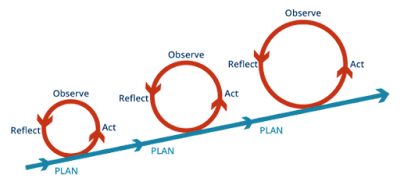
I used the action research framework as an approach for guiding my practical work. According to McNiff (2002), action research is a structured approach for improving one's practice, and it follows a cycle. The action research cycle is to plan, act, observe, and reflect. 

O'Byrne, W., (2016). Action Research Cycle.

Monday, October 25, 2021

Feedback

Feedback and suggestions about my body of work from my crit with Marlene de Beer:

Overall all the pieces are bulky/heavy due to them being cast.

Sunflowers

  • The large sunflowers are too large for the earpiece but could work for a pendant
  • The small studs are the only dainty piece there is
  • The sunflower in the middle of the teardrop is predictable and the top of the tear drop doesn’t look appealing
  • The pendant -the setting is on the same level as the  petals so it’s very flat

Succulent and bone pendant

  • add a catch to the chain to prevent it from being too long
Organic chain:
  • Why cast the links instead of making them in wire? 
  • The succulents in their 'pots' don't make sense on their own
  • The succulent 'works' with the heavy chain (I assume this meant proportionately
  • Agrees that the succulent shouldn’t be a pendant, adding a second one can prevent this.
  • The links naturally overlapping/ knot, consider making it intentional
  • The links are tick, thinner links give more design possibilities
  • Continue exploring the use of the links

Feedback on the chain from Samantha:
  • The ring the succulent is on is too thick and could be replaced with a thinner and smaller jumping
  • Think about forging the links
  • Use thinner wire for the connecting jumprings
  • Shorten the chain as it is a bit long.

Bowes, K.,(2021). The layout of my work thus far.