Showing posts with label Reflection. Show all posts

Thursday, December 16, 2021

Donald Schön

 Donald Schön wrote a book called The Reflective Practitioner (1983) in which he explains that creatives, " know more than they can say," and often only reveal their vast knowledge whilst actively producing work.  

"There are actions, recognitions, and judgements which we know how to carry out spontaneously; we do not have to think about them prior to or during their performance." These spontaneous actions are depicted through the decisions made whilst I design, prototype and produce my body of work. From what I understand from Schön's book "reflection in action" is done by recognizing the spontaneous decisions and recording them.

Unfortunately, I was unable to find Schön's, 1987, writing about reflection on action but I found a research paper that refers to his writing (Hugh, 1989). The paper explains how reflection on action is about learning from the experience which is usually overlooked. From this I understand that reflection on action happens after each piece has been produced.

Due to reflection in action taking place simultaneously to producing work this writing tends to be informal. Whereas reflection on action happens after the piece is completed therefore this writing is more formal.

A. Schön, D., 1983.  Sopper.dk. Available at: https://www.sopper.dk/speciale/arkiv/book49.pdf [Accessed 16 December 2021].

Hugh, M., 1989. Files.eric.ed.gov. Available at: https://files.eric.ed.gov/fulltext/ED309163.pdf [Accessed 16 December 2021].


Saturday, November 13, 2021

Platinum Reflection

I reflected on my completed platinum piece to recognize what parts of the design were successful and what hindered me from making the top 10 of the competition according to the feedback I received from the organisers of the Angloplat design competition. I used Liz Taylor's Levels of Reflection (2017) to reflect on my platinum piece.
  • What did I accomplish?
I designed and finished a pair of statement earrings that I entered into the Anglo Platinum Competition; the theme was a metamorphosis. The competition was open to students and professional jewellers, the only limit was that students were only given 20grams of platinum. I used my 20grams to make a wireframe to support my skeleton leaves embedded in epoxy.

  • What is important about what I did?
In terms of self-development, I was given the opportunity to work with metal most jewellers don't get the opportunity to and I don't know if I will get a chance to enter the competition again. It was an opportunity to learn to use another material, in this case, epoxy, which gave me a way of combining my actual leaves with metal. The whole process started with making various prototypes. The skeleton leaves were the starting point for my fascination with the natural work so they are important to me.
  • Where could I use this again?
    • Epoxy-I could use to preserve other organic materials
    • Platinum- In future client work
    • Skills- I could make smaller earrings for my website or use the skills I learnt to incorporate the epoxy into other jewellery forms

  • Are there patterns in my work/behaviour?
Work- Finding a way to preserve my skeleton leaves and make them durable, in high school I used wood glue and now I used epoxy to make leaves appear fragile but wearable. 

Behaviour- I struggled to find a starting point but once I had an idea I made test pieces.

  • How well did I do and what could be done differently?
I personally felt like I did well because I finished the piece and submitted it even though there were external interruptions. If I had more time the earrings would have been smaller to reduce their weight, I would have been more selective in the size and shape of the leaf used. 
In terms of the competition, I did not make the top ten because of the weight of the earrings which I kind of expected, because I did not emphasise the platinum enough.
  • How can I use this knowledge in my future work?
For my future work, I need to work with deadlines so I have more time to make prototypes and finish of pieces that I start. I also gained knowledge on how to taper wire and work with epoxy which I can add to my skills that could possibly use in my work in the future.

Taylor, L., (2017). Levels of Reflection

Sunday, August 1, 2021

Entrepreneurship Reflection

 The Wadhwani Foundation program got me thinking about setting up a website to sell my jewellery especially since Covid has suspended all physical markets. The only thing is I will probably need to set aside about a week to just focus solely on the website. Even if I set up the structure of the website and add my jewellery later. 

Some other important concepts of website building I need to consider are:

  • a logo
  • mission statement
  • photography of my jewellery
  • artist statement
  • an active social media account

Mass production Reflections

I feel that the different types of mass production are appropriate for different projects. For example, my wire earrings are made of wire that is too thin to cast which is why I made the jig. Whereas my sunflowers need to be cast because there is no way of making it up on a jig. 

So far I am mostly going to be using lost wax casting for my mass production. I plan on making moulds of all my sunflower elements and the links for my organic chains. Each element individually can be used to make spin-off pieces for the market which will probably take the form of a website.

Bowes, K., (2021). Broken wax pieces.

Collaboration Reflection

 Collaborating isn't something that I do often so it was interesting to try it. Each collaboration was important. With Courtney, I learnt valuable skills for working in wax. My work with Leanne is simple but it taught me the importance of social media. Her business has become known by social media alone, it can help a business reach a wider audience. My work with Amy was the most important as it influenced my design development.

The only collaboration I still have on the go is the one with Leanne but I don't think I will be doing any more anytime soon. I will admit though that even though I enjoyed learning, I don't like the stress of if I am portraying the person's concept correctly especially when they know exactly what they want.

Bear, L., (2021). Solace rings.

Platinum 2021 Reflection

I am so glad I have found a way to somewhat make my own skeleton leaf out of metal. I think learning to anodize aluminium might inspire and influence many other designs. I was just about to start prototyping with anodizing when the Covid lockdown rules changed denying me access to the workshop. 

The official competition deadline passed, I am unsure if I will get the opportunity to still make the piece using platinum but whether I do or don't I plan on still finishing the piece in silver or possibly gold.

Bowes, K., (2021). Prototype.

Organic chain reflection

The chain designs were a result of procrastinating from the sunflower earpiece design. Now that the drawing are done I want to make the out of wax for casting. Once the links are cast I need to make a mould so I can mass produce the individual links. When the links are cast I can start playing with the chain designs even further. I have been thinking about using a mix of different metals. I have also been thinking I could use the plain links for earrings.

Bowes, K., (2021). Wax link and casting.

Sunflower Reflection

I need to finish cleaning up the castings because I still need to work on the other element of the earpieces such as the buds, leaves and vines. I also need to figure out how I am going to put all the pieces together. I am definitely going to be making a mould of the tiny sunflower and element as they can be used for spin-offs. the larger flowers that won't be used in the earpiece can be incorporated into spin-offs as well. I am so glad that the original piece led to possible spin-offs so I am not working on only one design with my sunflowers.

Bowes, K., (2021). Dried sunflower.

Leaf Skeleton Reflection

Last year, the outcome of my stencil enamels was more of an abstract photocopied pattern rather than a leaf. Casting the skeleton didn't work out so I gave up trying to make the leaf altogether.

My casting with the skeleton leaf pattern made me realize I can look at the skeletons as a pattern and not as the leaf all the time. I am excited to see if the finished piece I planned for the platinum project will be the replicated skeleton leaf I have had in my head since the beginning that I didn't know how to achieve. I definitely want to continue exploring different ways to incorporate the leaves in my work as either replicas or as a pattern.

Bowes, K., (2021). Macro photo of a skeleton leaf.

Saturday, July 31, 2021

Continuing with paper

Bowes, K., (2021). Me making paper.

Making paper was very exciting and a break away from making jewellery. It is something I hope to continue doing. I want to use my paper to paint on or to bind my paintings together into design booklets. I plan to experiment with making paper at home because making paper can be a long process. If I make it at home I won't be wasting my manufacturing studio time to make paper. Otherwise, I was thinking about possibly making a deal with Amy that she will supply me with paper in exchange I will supply her with skeleton leaves.

Watercolour Reflection

I plan to use watercolours to document my design process. My paintings so far were to practice mixing colours and were mostly for fun. I plan to continue painting for fun until I have jewellery pieces or elements that are at a point where I want to paint them. I also haven't tried painting on my handmade paper yet so I want to experiment with that.

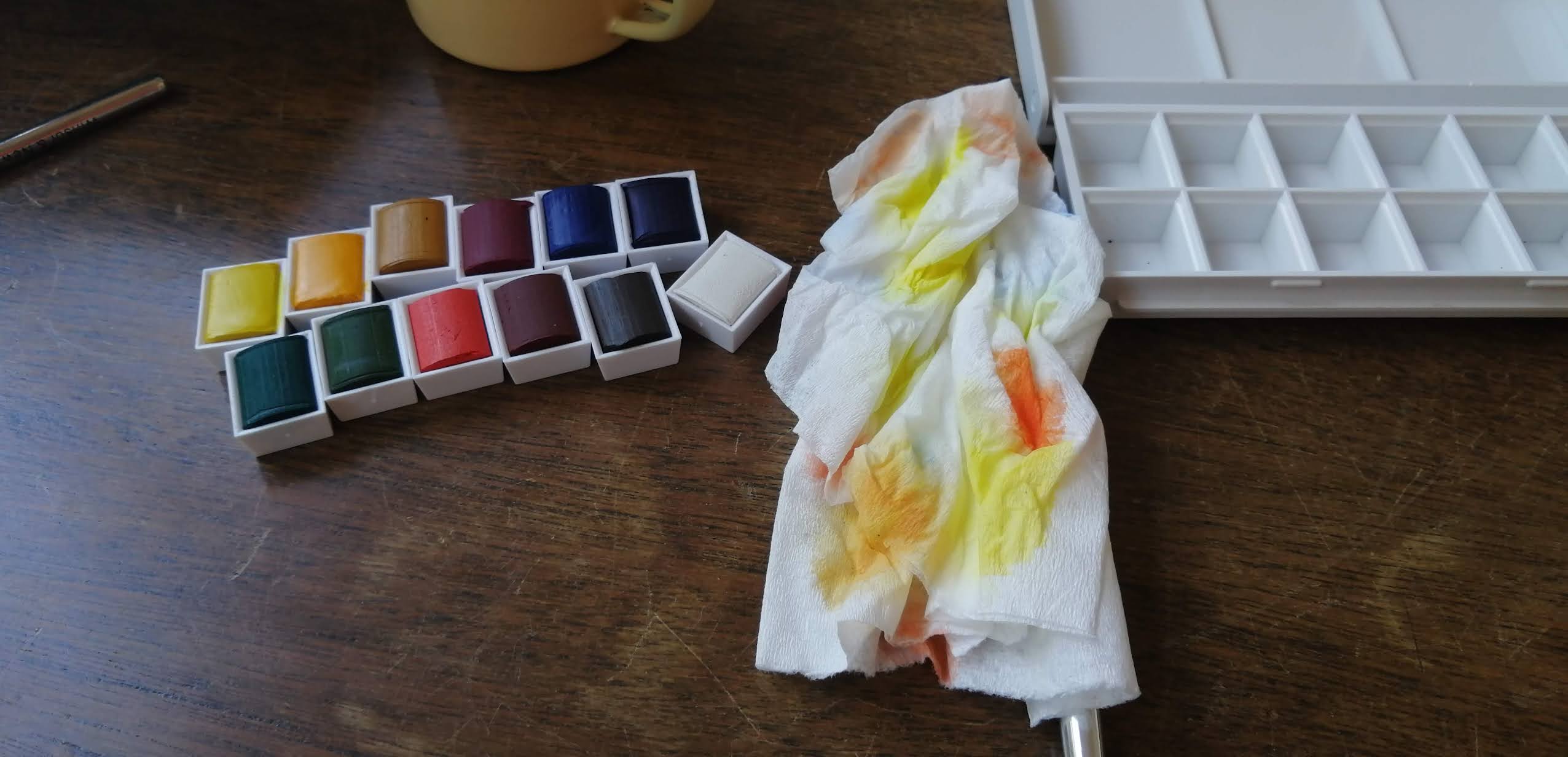
Bowes, K., (2021). Watercolour paint on tissue.

Influential jewellers reflection

The two references are quite different but both relate to my work. Ringgold influenced my designs by inspiring me to use my castings from last year. Pujol influenced my marketing by her use of an Instagram account and website. I still need to look for jewellers that look at mass production and other parts of my design development, for example, paper. 

I also plan on having a semi-structured interview with Michelle Pujol to determine the overlap, if any, between her personal design process and my own.

Ringgold, N., (n.d.). Chinese Lantern