Showing posts with label Chapter 3. Show all posts

Wednesday, December 15, 2021

Chapter 3 conclusion

Each design was developed by exploring different materials and techniques. Even though the pieces were so different I managed to group them into three collections. I showcase these collections on the Wix website I designed. I do not feel that these collections are complete and I plan to make more pieces to add to my website. I explored mass production using mould making lost wax casting. This increased the number of pieces I produced for my website and means I will have a mould to remake pieces to produce stock for the website.

For the sunflower collection, I plan to spend time trying to perfect all the elements that will complete the earpiece. I plan to continue working with my leaves in epoxy to produce simple and wearable pieces that will be added to the leaf collection. The chain links I feel have a lot of potential as the shapes are simple and can be reused in many new designs. The advantage of having designs I still want to create means I can continue to add to my website, the more pieces I add the larger the audience I will appeal to. Producing my body of work was rewarding, especially to see how everything came together to produce a functional website.

Chapter 3 Introduction

 In this chapter, I separate the work I produced throughout the year into the three foci that make up my research question: which are: design development, mass production and marketing. I did this with the hope of finding an open-ended conclusion to my research question and sub-questions. Under design development, I showcase the finished pieces in my three collections and each piece is accompanied by a summary of the process that lead to the final piece. I discuss the method I chose to explore for both mass-producing pieces and marketing them.

Design books

Unfortunately, the videos of my four design books are too large to upload onto blogger so I posted the videos of my design books onto my Instagram so that they will be in the journal on my website. I also uploaded my videos to youtube: chain designschain linksleaves and sunflowers

The first design book consisted of the mass-produced designs that I folded into signatures. I hand-stitched and bound the signatures together. For the final books, I wanted to ensure certain photos stood out in the book so I printed important photos on gloss paper. I planned the layout of each signature. I used my sewing machine to stitch them together as hand stitching was too loose. I added two small watercolour paintings into my design books which contrast the printed images the same way the handmade paper covers contrast with the smooth card used for the signatures. I 


Sunday, December 12, 2021

Design Development

The designs I developed this year, I categorised into three collections:
  1. Leaves
  2. Sunflowers
  3. Chain Links
Each collection consists of a focal design and spin-off pieces. The spin-offs were generated whilst developing the focal piece, as a by-product of the focal piece and just by having similar subject matter. In between working on my body of work, I learnt how to make paper which I used to compile design books for each collection.

Bowes, K.,(2021). Collections.

Marketing

 I started the year off with an online Entrepreneurship course organized by the Wadhwani Foundation in India. The course gave me insight into how to start a business and how to move a business online. Which intrigued me as with the Covid -19 virus a website seemed to be the best option because the I heart market closed and is not allowing new jewellers to join. 

ArtBusiness.com  has articles for artists on a range of topics one being the Do's and Don'ts, How to Build a Website that Works I used this article to generate a checklist of what to add to my website. I tested how simple it is to make my own website with both WordPress and Wix. I had more success working on Wix and continued with Wix to develop the website. I settled on a layout of the website and added all of my jewellery pieces. It was very rewarding to see all my hard work come together to produce my website.

As I continually make more jewellery I will add and edit my website. I hope to have a small variety of pieces that will appeal to a large audience of people.

Bowes, K.,(2021). Website Home Page.

Pendant- spin-offs

The image below shows a collection of sterling silver pendants inspired by my organic chain links.

Bowes, K.,(2021). Link pendants.
 

Both of the pendants were put together from the textured links. Not all of the textured links were successful so I decided against making moulds of all the textured links and rather use the successful links to make finished pieces, as seen below.

Ring - Spin-offs

The image below shows a collection of sterling silver rings inspired by my organic chain links.

Bowes, K., (2021). Link rings.

The spin-off rings are derived from my organic chain like the earrings. They were also made with the intention to sell either at the market or on my website. For the rings, I tried to hide the link in the design so the use of the links is not as obvious as the spin-off earrings. The plain double band ring and the teardrop ring sold at the recent I heart market.

Organic Chain

Figure 1 is my completed organic chain with links cast in copper and silver.  Figure 2 shows the chains' focal link that consists of a ring cast in gilding metal and a succulent cast in silver.

Figure 1- Bowes, K.,(2021). Organic chain.
Figure 2- Bowes, K., (2021). Chain details.


Whilst working at Phile Bear jewellers I was tasked with casting a chain. I wanted to make the most of my experience so I used an app called ArtFlow to mass-produce designs of my own organic chain with three different shaped links. I designed chains using the shapes individually and by mixing them.

Whilst designing I thought about using succulents I cast in silver last year as a focal point. The petals of the castings were fragile so I designed the succulents to sit in a 'flower pot' to add stability to the petals. I used ring wax to cast the 'flower pots' in gilding-metal creating a two-toned piece.

From my experience casting at Phil Bear, I learnt that it is better to cast the links closed. I moulded each of the links in waxcast them, made a mould and then cast multiples of all three shapes. I cast in copper, brass and silver so that I could play with combining the different colours because the focal point is two-toned. I planned to put together two chains; one copper the other brass both with silver details. I connected the links with jumprings. The first chain was too long so I shortened the chain making the focal point less centralized like a pendant, as seen above.

I took inspiration for my chains from Nicole Ringgold's chains to use my cast succulents except I didn't want my chain to be as fine. I looked at Louise Partain's chains next but Partain uses organic objects to create her links. In the end, my chain resembled Naomi Tracz chain's just not as heavy.

Due to the links being cast and having a mould made of them I can continually come up with new designs that incorporate the links.

Thursday, December 9, 2021

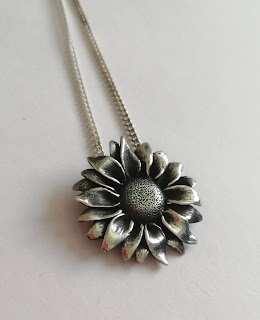
Half Sunflower Pendant

 Below is half a sunflower made up from pieces of the brooch sunflower and pendant sunflower that were joined in wax and cast in sterling silver.

Bowes, K., (2021). Half sunflower pendant.

Having moulds of my large and medium sunflowers meant that I could break down the sunflower into smaller elements. I layered the parts of the flower in wax, cast them and once again made a mould of the half sunflower so I can always use it again. My 2019 platinum pendant sparked the idea of using the half sunflower as a pendant, as seen below.

Wednesday, December 8, 2021

Wearable Sculpture

Figure 1 shows a sculptural casting, cast in gilding-metal, attached to a beaded chain. The sculpture is comprised of a succulent and vertebra found on the beach.


Figure 1-Bowes, K.,(2021). Wearable sculpture.
 

Figure 2-Bowes, K.,(2021). Close up of the sculpture.


In 2020 I cast a vertebra I found on a beach and made a mould of. I paired the vertebra with a casting of a succulent cast from a live plant; similarly to how Nic Bladen casts using living plants. The castings were done separately but a serendipity photo of the two castings together ignited the idea of making the castings into a sculpture. 

I used my Artflow app to design how I could use beads to make the sculpture wearable. Youtube became a useful tool to learn new types of beading but I settled on using a double helix beading design similar to DNA emphasising something that is living and growing.

Above is the finished piece of the sculpture attached to the beads before the contrast can form between the vertebra which is sealed with a clear lacquer and the succulent which isn't sealed.

Venation Ring

The images below show a ring with a venation pattern cast in gilding metal.

Bowes, K.,(2021). Wearing the ring.
Bowes, K., (2021). Venation ring.

The ring started off as a collaboration with a Graphic Design student, Courtney Shelly. The collaboration required transferring an image to wax to cast a ring. As a prototype for the collaboration, I tested the transfer technique with my own venation pattern from last year. I decided to cast and clean up the prototype ring so it became a piece for my body of work.

Paper

Amy Pieterse from the Fine Art department taught me the process of making paper from the fabric. I really enjoyed making paper as it was a great break away from making jewellery. We made two batches of paper the first was blue and the second batch was made with 'white' fabric producing off-white paper, as seen in the photos below. I experimented with incorporating my skeleton leaves into the paper and painted with the dye runoff from the fabric. Making paper is something I definitely want to continue exploring.

Bowes, K.,(2021). Handmade paper.
Bowes, K., (2021). Close up of paper.

Tuesday, December 7, 2021

Earring spin-offs

 The image below shows a collection of sterling silver earrings inspired by my organic chain links.

Bowes, K.,(2021). Link earrings.

I played with textures and the different sized links to generate a collection of spin-off pieces from my organic chain. I made the spin-offs for the I heart market which has started up again. I also added them to my website as I do have moulds of the links and could always make them again. 

The hoop-like earrings I made were inspired by Naomi Tracz's Dalia Hoops. I know she uses her heavy marquise shape so I added a twist to my marquise set and left the other link flat as they have an interesting side profile. The Marquise studs were sold at the I heart market.

Sunflower brooch

Below is an image of a sunflower brooch that was cast in sterling silver.

Bowes, K., (2021). Sunflower brooch.

In my quest to find the right size sunflower for my earpiece, I experimented with moulding a sunflower out of wax. I doubled up the petals so that the sunflower looks full like my reference. For the centre of the sunflower, I researched the Fibonacci spiral and tried transferring the spiral onto the wax. Unfortunately, the pattern didn't translate once the sunflower was cast. I used a bur to drill divots so that the spiral changed from a pattern into a texture. The cast sunflower was far too large for the earpiece so I used it for a brooch, as seen above.

Wednesday, December 1, 2021

Sunflower pendants

Figure 1 is a sunflower cast in sterling silver on a beaded helix chain and figure 2 is a sunflower cast in sterling silver on a chain.

Figure 2- Bowes, K.,(2021). Pendant on a chain.
Figure 1- Bowes, K., (2021). Sunflower pendant.


With the brooch sunflower being too large I tried again hoping to make the right size sunflower. I left the centre of the flower blank so that after I made my mould I could try to texture it in wax. I stippled the centre of one sunflower in wax (as seen in Figure 1) and textured a second sunflower after casting with a tiny ball bur(as seen in Figure2).

My second attempt was still too large so I decided to use the medium size sunflowers as pendants. I wanted to bring in some colour so I used the same beading technique for my wearable pendant. Except I used back and yellow-orange to try to match the colours of a sunflower(Figure 1). The second sunflower I chose to add onto a chain to keep it simple(Figure 2).

Sunflower cuff

Figure 1 shows an ear cuff made that was moulded in wax and cast in sterling silver.

Figure 2- Bowes, K., (2021). Wearing the cuff.
Figure 1- Bowes, K.,(2021). Finished cuff.


The sunflower collection was inspired by a set of detailed ceramic tiles. I used these tiles to digitally design an earpiece, to personalise the design I edited it to incorporate a sunflower as at the time I was growing sunflowers in my garden.

I spent a lot of time moulding different sized sunflowers in soft wax, cast them and used them to make moulds. On my third attempt, I managed to make a sunflower small enough for the cuff, as seen in Figure 2. The earpiece only got as far as the cuff, as seen in Figure 1. I spent so much time trying to get the sunflower right and would like to spend some time getting the buds and leaves proportionate to the sunflower.

 The other sunflowers I kept and used to make spin-off pieces. Thus going against  Michelle Pujol's advice to complete the original design first because all the sunflowers were already cast and I did not want them to go unused.

Tuesday, October 5, 2021

Sunflower studs

Figure 1 shows my smallest sunflower that was cast in sterling silver and figure 2 shows another set of the same sunflowers but they are attached to teardrop links from my organic chain.


Figure 2- Bowes, K.,(2021), Sunflowers on teardrops.
Figure 1 -Bowes, K.,(2021), Sunflower studs.


Knowing that I have a mould of my smallest cast sunflower, I thought they would be the perfect size to make small studs for the I heart market and my website.

The studs are small, as seen in Figure 1, but they take up most of the lobe when worn. Therefore it is difficult for people with multiple lobe piercings to wear another pair of earrings next to the sunflowers.  I attached the sunflower to a teardrop link, as seen in figure 2, which should allow for a second earring to be worn.

Sunday, August 29, 2021

Platinum 2021

Figure 1 below shows my platinum competition submission piece, statement earrings. They are made from a leaf skeleton embedded in epoxy with a platinum frame.
Figure 1-Bowes, K., (2021). Final Platinum piece.
 

Figure 2-Bowes, K., (2021). Details.

My statement earrings, as seen in Figure 1, are what I made for the Anglo Platinum competition.The competition brief provides design hooks as a designing starting point but I didn't find these very helpful so I compiled my own design hooks from personal references. Part of the requirement was also to consider who the piece is made for, the client.

From my personal design hooks I settled on working with fibers. I found a fine aluminium mesh that was easy to manipulate to create forms similar to that of my natural skeleton leaves.I attempted to braid silver wire to make my own mesh but failed so I continued working with the aluminium mesh to prototype making leaves with silver veins. The prototype didn't  create a 'natural' looking leaf so I doubled up the mesh and also researched anodizing the aluminum mesh. The silver veins were also a struggle because as the work-hardened they snapped. 

After the lockdown levels changed I missed the competition deadline but was luckily given a limited extension. I revised my plan of what I was going to make and decided to work with my skeleton leaves and place them in epoxy to save time. The epoxy became ideal as it is easily shaped in hot water. There are different types of epoxy so I tested three different types to compare colour and flexibility. The only difficulty I was finding a way to keep the epoxy thickness even because if the epoxy is too thin it tends to crack, I ended up using a perspex frame.

I digitally designed how I can use the epoxy leaf to create an earring. My first prototype I assembled using a tapered silver wire but the epoxy wasn't secure so I experimented with adding side wires, 'veins', to add stability. For my second prototype I used the side wires to 'set' the epoxy leaf. From all that I had learnt I made a final prototype using a clearer epoxy and made the leaves white so they stood out. From the new white leaves in the clear epoxy I chose my leaves for the final piece and made the frame out of the platinum, as seen in Figure 2, I received from the competition.

I unfortunately did not make it to the top 10 in the competition but I did receive feedback. Reflecting on that feedback the biggest concern was the weight of the finished earrings. I really wanted to make smaller and simpler earrings using the epoxy but completely ran out of time to make them this year.

Friday, July 9, 2021

Mass production Summary

There are many ways to mass-produce when making jewellery. I practised three different forms of mass production:

  1. ArtFlow is an app I used on my tablet to mass-produce designs.
  2. I made a jig for the wire earrings I make for the I heart market that sell really well but take time to make individually.
  3. The process I used the most was making moulds and lost wax casting.

Lost wax casting became second nature to me as I have been working part-time at Phil Bear Jewellers where I cast at least once a week. I was allowed to do the casting for my own designs with the casting for the business meaning that working part-time didn't interfere with my manufacturing time.


Bowes, K., (2021). Wax trees at Phil Bear Jewellers.
Bowes, K., (2021). Wax and mould.