Showing posts with label Beads. Show all posts

Wednesday, December 1, 2021

Sunflower pendants

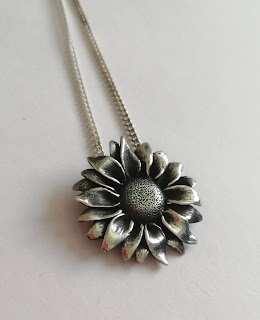
Figure 1 is a sunflower cast in sterling silver on a beaded helix chain and figure 2 is a sunflower cast in sterling silver on a chain.

Figure 2- Bowes, K.,(2021). Pendant on a chain.
Figure 1- Bowes, K., (2021). Sunflower pendant.


With the brooch sunflower being too large I tried again hoping to make the right size sunflower. I left the centre of the flower blank so that after I made my mould I could try to texture it in wax. I stippled the centre of one sunflower in wax (as seen in Figure 1) and textured a second sunflower after casting with a tiny ball bur(as seen in Figure2).

My second attempt was still too large so I decided to use the medium size sunflowers as pendants. I wanted to bring in some colour so I used the same beading technique for my wearable pendant. Except I used back and yellow-orange to try to match the colours of a sunflower(Figure 1). The second sunflower I chose to add onto a chain to keep it simple(Figure 2).

Monday, October 25, 2021

Wearable sculpture

 My plan to develop my sculpture into a wearable piece started with a drawing and a plan to use beads. I knew beads would be a great way to bring some colour back into my work. I managed to find green beads similar to the colour of the living succulent and the white if the string is similar to the white details of the plant. 

I researched different beaded chain techniques and the "Two Bead Spiral Herringbone Rope" stood out to me as it resembles DNA. "DNA [...] is a long molecule that contains our unique genetic code,"(DNA, the code for life, n.d.). "Like all living organisms, plants use deoxyribonucleic acid (DNA) as their genetic material,"(Grotewold, Chappell and Kellogg, 2015). The beads I used were bought last year and match the colour of the original succulent.

Bowes, K.,(2021). Drawing

Bowes, K.,(2021). Sculpture and beading.


FutureLearn. n.d. DNA, the code for life. [online] Available at: <https://www.futurelearn.com/info/courses/the-genomics-era/0/steps/4867> [Accessed 22 October 2021].

Grotewold, E., Chappell, J. and Kellogg, E., 2015. Plant Genetic Material.[online] Available at: <https://onlinelibrary.wiley.com/doi/pdf/10.1002/9781118539385.ch1> [Accessed 22 October 2021].

Tuesday, May 19, 2020

Making Masks

Putting my embroidery and stitching skills to some use I decided to make some face masks. I used the embroidery I had been working on for some time to make the first mask as I had no clue what I was going to do with the embroidery once it was done (Fig. 1).

After my first mask was successful, I had enough material to make a second one. I wanted to try stitch a flower, but I wasn't sure which flower at first. I eventually decided to stitch Forget-Me-Not flowers (Anchusa capensis) which are five-petaled blue flowers with yellow centres. They are indigenous to South Africa. I was given a packet of Forget-me-not seeds with my dog's ashes at the beginning of the lockdown. I haven't planted the seeds yet and I don't know if I will.

I started stitching with a dark blue thread as it was the only thread, I had at the time but when my local haberdashery opened I managed to get a blue thread closer to the colour of the flowers. I used yellow beads for the middle of the flowers which added another texture. The beads also catch the light drawing attention to the flowers so they don't get lost on the blue background.

I want to make a few more masks with some embroidery but I want to try sewing them up with the sewing machine as the embroidery takes time and stitching by hand makes the process a lot longer.

Figure 1 - Bowes, K ., (2020). abstract embroidery mask.
Figure 2 - Bowes, K., (2020). Forget-me-not embroidery mask.

Friday, March 6, 2020

Beads

Figure 1- glass seed beads
I forgot to post about this but on the 26th of February, we had a visitor from overseas that is doing research on different kinds of beads. The advanced diploma students including myself took a walk to our local bead shop near the Victoria Street market.

Buying beads was very frustrating as the mean behind the counter at the shop was colour blind. I pointed out a bundle of ocean green beads on display that I was interested in buying. It took the man 5min to find the exact colour, I had pointed out, among the beads in stock as the beads on display are usually not for sale. The man would show us beads of the same shininess but of the wrong colour which was very frustrating.

There were green beads in stock but only in a size two which means you have to buy the bundle which is about six strands on beads instead of buying individual strands which they do for the size 1 beads. Instead, I chose three different strands of size one beads, as seen in figure 1, that I felt were a mix of all the colour reflected in the originally ocean green beads I was interested in. The three colours, turquoise, teal and peacock green, that I bought are all shiny also like the original ocean green beads.