Showing posts with label Texture. Show all posts

Monday, August 3, 2020

Platinum texture II

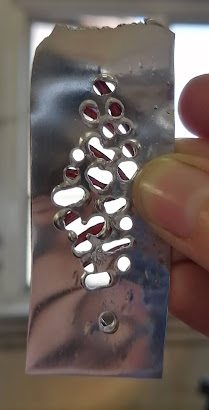
Melting the pattern/texture in platinum was in some ways different and the same as melting silver.  The platinum doesn't texture like silver does but it does bubble, like silver which was surprising. That means I need to forge the claws before trying to set them like I did with the silver otherwise they might break off.

The interesting thing about melting the platinum was in silver I drilled two holes and pierced between them to melt the longer holes, but this did not work in platinum. In the platinum, it just melted one hole and fills the second drilled holes. For me to melt elongated holes I had to push the metal with the hot flame.

I first thought I was overdoing it with the number of holes but once I finished and placed the enamel over it, I am very happy with it. This would set off anyone that has Trypophobia (the fear of clustered holes, bumps, or patterns).

Bowes, K., (2020). Enamel over the texture.
Bowes, K., (2020). Enamel viewed from the back.

Wednesday, July 29, 2020

Platinum Texture

I wasn't sure how the platinum would melt and if it would texture at all so my plan was to use a textured steel block to add texture to my platinum and then melt the holes for my pattern. I used a steel block I was given have had a deep grove on the one side and added more marks to create the texture (Fig.1). I did test the texture on a piece of silver as seen in figure 2.

I had a small extra piece of the platinum plate so I decided to test how the platinum would melt and see if it does texture in any way or not. The platinum melts beautifully (Fig.3) and I do not think I need the steel block texture at all. I just need to remember to reduced my flame and use the annealing goggles because with the melting goggles are too dark and by the time the metal had heated up enough for me to see the hole had melted too large. 

Figure 1 - Bowes, K., (2020). Textured steel block.

Figure 2 - Bowes, K., (2020). Textured silver.


Figure 3 - Bowes, K., (2020). Melted platinum.

Wednesday, July 15, 2020

Melted texture

I face the challenge of trying not to pierce the pattern in platinum as this can lead to losing metal easily. It was suggested that I try to drill and melt the pattern holes into the metal. The risk with this is the way copper, silver and platinum melt are all different so it will be difficult to predict the outcome in platinum.

I attempted this technique in copper but the copper pulls to one side creating blobs. I would have been ok with the idea if the copper pulled evenly around the edges.
Bowes, K., (2020). Copper 

I then experimented in silver as copper, silver and platinum will all react differently. The silver melted without leaving blobs and the surrounding metal creates a reticulated texture. 
Bowes, K., (2020). Silver melted texture

I am definitely considering using this as it will create texture on the platinum, I just hope platinum has the same or similar reaction as the silver, which will make the pattern less flat meaning there is no need for the cast succulent. I think this will also link closer to my tree reference that inspired the abstract pattern as the outer tree does not have a very textured bark and the inner tree has a very rough textured bark.