- Anon. 2020. The Difference between Custom and Mass-Produced Jewelry. Available at: https://www.jewelrythis.com/blog/the-difference-between-custom-and-mass-produced-jewelry/ [Accessed 20 July 2021].
- Anon. n.d. Merriam Webster Dictionary- produce. Available at: https://www.merriam-webster.com/dictionary/produce [Accessed 21 October 2021].
- Anon. n.d. Merriam Webster Dictionary- sacred. Available at: https://www.merriam-webster.com/dictionary/sacred [Accessed 21 October 2021].
- Bernabei, R., 2011. Contemporary Jewellers: Interviews with European Artists. Engliand: Berg Publishers
- Bladen, N., 2015. New Archived Work — Nic Bladen. Available at:http://www.nicbladen.com/blog-page/2016/6/11/solo-exhibitions-season-at-tswalu [Accessed 7 December 2020].
- Bladen, N., n.d. NicBladen. Available at: https://www.nicbladenbotanicals.com/ [Accessed 7 December 2020].
- den Besten, L., 2011. On jewellery: a compendium of international contemporary art jewellery. Stuttgart: Arnoldsche.
- Henderson, G., 2020. The Importance Of Social Media Marketing. Digitalmarketing.org. Available at: https://www.digitalmarketing.org/blog/the-importance-of-social-media-marketing [Accessed 20 July 2021].
- Joyce, L., 2017. The Meaning of Contemporary Jewellery. Available at: https://medium.com/@Lavonne/the-meaning-of-contemporary-jewellery-3af4fff44a6c [Accessed 16 November 2021].
- Koberg, D. and Bagnall, J. 1981. Design process, feedback (diagram). Los Altos, Calif.: W. Kaufmann.
- Koberg, D. and Bagnall, J. 1981. The revised all new universal traveller. Los Altos, Calif.: W. Kaufmann.
- Makomba, M., 2021. 10 things you can do to tackle the risk of small business failure. Available at: https://www.yoco.com/za/blog/article/tackle-small-business-failure/ [Accessed 1 December 2021].
- McNiff, J., 2002. Action research for professional development. Available at: https://www.jeanmcniff.com/ar-booklet.asp [Accessed 27 May 2021].
- Metcalf, B., 1994. On The Nature Of Jewelry (Part 2) Restriction & Reparation. Available at: https://www.brucemetcalf.com/on-the-nature-of-jewelry-part-2 [Accessed 8 July 2020].
- Metcalf, B., 1998. On The Nature Of Jewelry (Part 1). Available at: https://www.brucemetcalf.com/on-the-nature-of-jewelry-part-1[Accssed 10 November2021].
- Milton, K., 1999. Nature Is Already Sacred. Available at: https://www.jstor.org/stable/30302283 (Accessed 10 November 2020)
- O'Byrne, W., 2016. Four steps to conducting action research in the classroom (diagram). Available at: https://wiobyrne.com/action-research/ [Accessed 7 July 2021].
- Olver, L., 2002. The Art Of Jewellery Design. London: A. & C. Black
- Partain, L., n.d. DELICATE HAMMER. DELICATE HAMMER. Available at: https://www.delicatehammerstudio.com/ [Accessed 14 September 2021].
- Pujol, M., 2021. Artist statement. Available at: https://michellepujol.bigcartel.com/artist-statement [Accessed 7 July 2021].
- Quickenden. K. 2000. Virtual Gallery of Contemporary Jewellery. Birmingham: University of Central England
- Ringgold, N., n.d. About. Available at: https://www.nicoleringgold.com/about [Accessed 1 June 2021].
- A. Schön, D., 1983. Sopper.dk. Available at: https://www.sopper.dk/speciale/arkiv/book49.pdf [Accessed 16 December 2021]
- Taylor, L., 2017. 10 Unique and Creative Reflection Techniques & Lessons for the Secondary Student. Available at: https://www.teachwriting.org/612th/2017/12/28/10-unique-and-creative-reflection-techniques-lessons-for-the-secondary-student [Accessed 3 September 2021].
- Taylor, L., 2017. 1Levels of Reflection (diagram). Available at: https://www.teachbetweenthelines.org/shop/levels-of-reflection-poster-and-pdf [Accessed 3 September 2021].
- Tracz, N., 2021. About. Available at: https://naomitracz.com/pages/about-naomi [Accessed 2 November 2021].
Showing posts with label References. Show all posts
Showing posts with label References. Show all posts
Tuesday, October 26, 2021
Reference list

Thursday, July 22, 2021
Reference list
- Anderson Feisner, E. 2006. Colour: How to Use Colour in Art and Design.Laurence King Publishing.Available: https://books.google.co.za/books?id=uw0JRpdKQ6MC&printsec=frontcover#v=onepage&q&f=false [Acessed 20 May 2021].
- McNiff, J., 2002. Action research for professional development. Available at: https://www.jeanmcniff.com/ar-booklet.asp [Accessed 27 May 2021].
- Pujol, M., 2021. Artist statement. Michelle Pujol : jewellery and painting. Available at:https://michellepujol.bigcartel.com/artist-statement [Accessed 6 July 2021].
- Ringgold, N., n.d. About. Nicole Ringgold. Available at: https://www.nicoleringgold.com/about [Accessed 2 June 2021].
Tuesday, April 20, 2021
Floral Tiles
Bathroom tiles that I keep saying look like an earring/earpiece. I also love how the floral image looks almost like a watercolour painting with a pen used for detailing.
 |
| Bowes.K., (2021). Bathroom tiles grid image |
 |
| Bowes.K., (2021). Single tile |
Wednesday, January 13, 2021
Referenecs
When I reached a point where I understood my theme and knew roughly
which techniques I wanted to experiment with, I looked for jewellers that I
could learn techniques from. I learnt new ways to set enamels from Nora Kovats
work. I also was inspired by Naomi James and Nic Bladen. James uses dried
plants to roll mill texture on metal and Bladen casts organic objects in metal.
Both jewellers are not doing harm to the environment as using part of a plant
or a dead plant will not kill an entire eco-system. Besides looking at the
surface of organic objects I am also interested in cellular growth.
Nervous Systems is a company that looks at cellular growth,
but I cannot look to them for their techniques as they write their own computer
programs to replicate nature. I admire them for their subject matter as they
can't see it forming in nature with the naked eye so they recreate it
digitally. Siobhan Doughty is a fine art student whose work I feel speaks to
mine in terms of the subject matter. I also think that our work could work well in
the same exhibition space.
I have not as yet found a jeweller that makes jewellery that combines casting, texturing metal and enamel most jewellers only stick to one technique but I want to make pieces that use different combinations of these techniques to make a cohesive body of work.
Monday, December 7, 2020
Nic Bladen
Nic Bladen (n.d.) is an artist that creates life-size sculpture castings of plants. His jewellery is a result of his lost casting experiments that lead him to his life-size sculptures. No two pieces are the same as he does not make moulds of his work, he casts from the natural object itself.
Nic Bladen's sculptures are very intricate and some of them
are made without harming the plant itself. An example of this would be his Boscia
Albitrunca (Bladen. 2015) sculpture, which is 3m x 4.2m x 1.6m, that was made by making a
mould of the tree and casting a single cast from the mould. Only some of the
branches were cast from live branches but it was ensured that these would not
kill the tree.
I have seen many pages on Instagram selling castings that
are made from cast plants like Burn out Castings, Silversmith nursery and Cactus and flora castings. They sell their castings for other jewellers to use
and are based overseas, whereas Nic Bladen uses his castings to make sculptures
and jewellery. He is also a South African artist which makes his work more
relatable to me as some of the plants used in his work are indigenous to Soth Africa.
 |
| Bladen.N. (2015). Boscia Albitrunca. Bronze sculpture with steel base |
Wednesday, December 2, 2020
Naomi James
Naomi James is a jewellery designer based in Brighton. She uses actual plants, feathers and botanical structures to create her jewellery pieces. She enjoys pairing contrasting textures from different plants and compliments some of her pieces with touches of 18ct gold.
I admire her as she designs as she works. This is something I struggle with as I always want to have a finished product in mind before making something. When I first saw her work, I was under the impression that she used metal clay or etching. As it turns out, all she uses is a roller to press the images into the silver.
 |
| James, N., (n.d). Dusty Miller Teardrop Studs. Stud earrings, sterling silver |
 |
| James, N., (n.d). Labradorite Medow Necklace.Necklace, sterlings ilver |
 |
James, N., (n.d). Small Round Leaf Studs.Stud earrings, sterling silver |
Sunday, April 12, 2020
Leaf photomicrographs
When I was playing with the Nervous System program, Radiolaria, to create my own patterns it reminded me of photomicrographs of a plant's leaf, root and stem. The photomicrograph images were taken from my high school biology notes.
 |
| Nervous System. (n.d.).Radiolaria. My pattern from the Nervous System program |
 |
| Bowes.K.own photo (2020).Photomicrograph notes |

Monday, March 30, 2020
Nervous system program
On the Nervous System website, they have access to a program so that their customers can make their own custom pieces for purchase. The one program Radiolaria works by giving a plain grid in which you have tools to manipulate the grid in different ways.
Figure 4 shows how I manipulated the grid and figure 5 shows the grid without the manipulation points. It also shows how your piece will look as a completed jewellery piece; you can also change the placement of the hook.
Figure 6 shows a piece of jewellery Nervous Systems made that used the Radiolaria program. I searched for the program that allows them to digitally grow venation (xylem) patterns but their program for growing xylem patterns is unavailable to the public.
 |
| Figure 4- Nervous System. (n.d.).Radiolaria.My manipulation points on the grid |
 |
| Figure 5 -Nervous System. (n.d.).Radiolaria Grid without the points |
 |
| Figure 6-Nervous System. (n.d.) Radiolaris bracelet, Silicone rubber |
Nervous system
Nervous System was founded by Jessica Rosenkrantz and Jesse Louis-Rosenberg in 2007. They use their own written programs and technology to replicate growth patterns in nature like cellular mitosis and xylem patterns but done on a computer. They use techniques such as 3D printing, laser cutting and etching to create their designs depending on the materials. Nervous System designs jewellery, lighting, houseware and puzzles.
Here, I have included some examples of their jewellery work and methods used. The rubber that they use is laser cut as seen in figure 1 but the brass in their work is photochemically etched. The designs have to be precise so they can tolerate the forming process, in which a hydraulic press is used, figure 2. Figure 3 is an example of a xylem pattern that they generated with their program that has been translated into a piece of jewellery.
 |
| Figure 1-Rosenkrantz, J.Louis-Rosenberg, J.,(n.d.). Crenulate. Lasercut rubber necklace and bracelet |
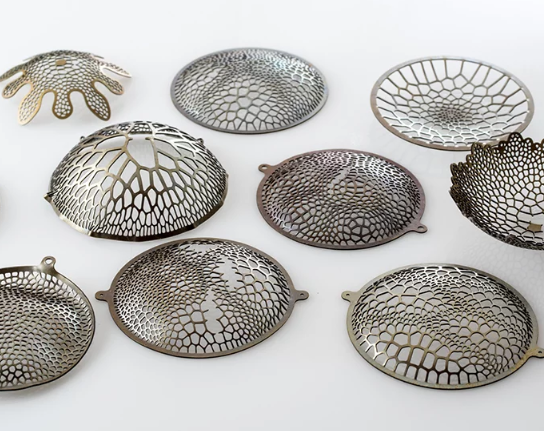 |
| Figure 2- Rosenkrantz, J.Louis-Rosenberg, J., (n.d.).Prototypes to test design for the forming process |
 |
| Figure 3-Rosenkrantz, J.Louis-Rosenberg, J., (n.d.) Xylem Brooch, etched leaf venation |
Thursday, February 27, 2020
Nora Kovats
Nora Kovats is a contemporary jewellery designer and illustrator from South Africa that is now based in Berlin. She works with silver and vitreous enamel. Nora Kovats uses botanical imagery in her pieces. She refers to her garden as an inspiration even though her mythical garden in her jewellery may not always reflect her physical garden. She uses the botanical illustrations of her garden as a surface to sieve enamels over while also using her illustrations to inspire the colours she uses in her enamelling process.
Her pieces are interesting as they are simple pierced pieces of metal that have been enamelled. Some of the pieces are domed and strung with beads or stones. She has different variations of the same techniques which are due to the fact that she chooses to create multiple pieces of jewellery at the same time. She states that this is because "it’s a creative process in several disciplines simultaneously."(Kovats,2020)
 |
| Kovats.N.(n.d.) enamelling over illustrations |
Her pieces are interesting as they are simple pierced pieces of metal that have been enamelled. Some of the pieces are domed and strung with beads or stones. She has different variations of the same techniques which are due to the fact that she chooses to create multiple pieces of jewellery at the same time. She states that this is because "it’s a creative process in several disciplines simultaneously."(Kovats,2020)
 |
| Kovats.N. (2017-18).Deep Sea Garden Monsters.Neckpiece, enamel and beads |
Subscribe to:
Posts (Atom)