Showing posts with label Interest. Show all posts

Tuesday, June 8, 2021

My handmade paper

I loved how the leaf skeletons knitted into the fibres of the paper so it became part of the paper. The paper also dried really thin which is why I also want to make white paper for creative booklets, with the paper being so thin the books won't get too thick.

Bowes, K .,(2021). Dried paper

Bowes, K., (2021). Leaf detail on paper.

Tuesday, July 7, 2020

Michael Kukla

Michael Kukla is an artist that creates two-dimensional and three-dimensional pieces exploring the "mystery of space - of standing in front of a thing and trying to visualize what it would be like to enter it, go behind it; pass through it with our minds' eye" (http://mkukla.com/about.html)

Breath #1, (two views) 2014, Marble, 8 x 6 x 2 inches 20 (x 15 x 5 cm)
http://mkukla.com/Stone/stone_01.html

Stratal 312, (plus detail), 2012, Laminated plywood, 24 x 12 x 6 inches (61 x 30.5 x 15 cm)
http://mkukla.com/Wood/wood_02.html

Cloud #3, (plus detail), 2014, Masking Tape, 88 x 60 x 8 inches 223 x 152 x 20 cm)
http://mkukla.com/Tape/tape_04.html

Untitled #15-2009, 2009, gouache on paper, 14 x 19 inches (35.5 x 48 cm)
http://mkukla.com/U/u_10.html

Monday, March 30, 2020

Nervous system

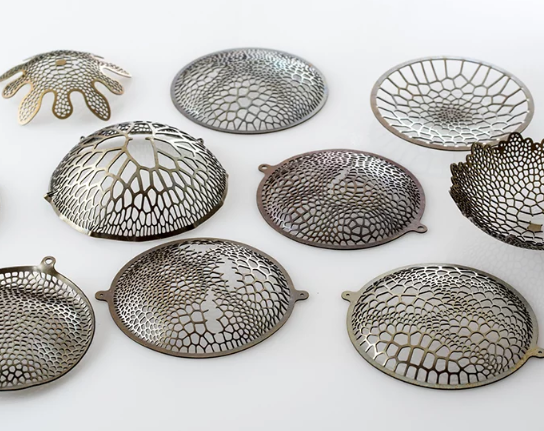
Nervous System was founded by Jessica Rosenkrantz and Jesse Louis-Rosenberg in 2007. They use their own written programs and technology to replicate growth patterns in nature like cellular mitosis and xylem patterns but done on a computer. They use techniques such as 3D printing, laser cutting and etching to create their designs depending on the materials. Nervous System designs jewellery, lighting, houseware and puzzles. 

Here, I have included some examples of their jewellery work and methods used. The rubber that they use is laser cut as seen in figure 1 but the brass in their work is photochemically etched. The designs have to be precise so they can tolerate the forming process, in which a hydraulic press is used, figure 2. Figure 3 is an example of a xylem pattern that they generated with their program that has been translated into a piece of jewellery.


Figure 1-Rosenkrantz, J.Louis-Rosenberg, J.,(n.d.). CrenulateLasercut rubber necklace and bracelet
Figure 2- Rosenkrantz, J.Louis-Rosenberg, J., (n.d.).Prototypes to test design for the forming process

Figure 3-Rosenkrantz, J.Louis-Rosenberg, J., (n.d.)  Xylem Brooch, etched leaf venation 


Friday, March 20, 2020

Vina Rust

 Rust, V. (2006) Stained cell series
 Rust, V. (2004) Sprout

This is some pieces from a body of work by Vine Rust where she looks past the surface of botanical structures. She uses illustrations and photomicrographs as inspirations. Cellular structures draw Rust in as the structures show variation in logical patterns. Her influences show a common thread of observations of nature and the appreciation of the tension between menace and beauty that are found in nature.


I really love her work it is so interesting because it looks like a slice of a cell and all the patterning is made from what looks like a bunch of individual tubes. It reminds me of filigree where they make the wire place it in the frame and then solder the wires in, I feel like she possibly uses the same process but instead of wire, she uses tubes which adds depth. I love the positive and negative spaces that the patterns and design make as to me it makes the jewellery look as if it's lightweight.

 Rust, V. (2008) Stained cell series
 Rust, V. (2004)  Stamen Series


https://www.flickr.com/people/verust/


Sunday, March 1, 2020

Embroidery

Human eye- punch needle embroidery
https://www.instagram.com/p/B8Q5hHbn8HJ/?igshid=gzxtaw3p2kmp 

Biological diagram of a human eye done in embroidery cotton and beads. An interesting combination of biology and art.